
ADHD Paralysis Explained: Why Your Brain Freezes (And How It’s Different from Depression)

ADHD paralysis is executive dysfunction—not laziness—caused by your brain’s planning system going offline under stress. Unlike depression (persistent low mood) or burnout (chronic depletion from overwork), ADHD paralysis is task-specific and responds to external structure and task breakdown. Accurate diagnosis through comprehensive assessment determines which evidence-based interventions will actually work for your specific situation.
Prefer to listen? Play the audio version of this article—perfect for your commute or morning routine.
Your Brain Isn’t Broken—It’s Overwhelmed
When you can’t start that project, respond to that email, or tackle the dishes piling up in your sink—that’s not a character flaw. That’s neurobiology.
For adults living with ADHD, the inability to initiate tasks isn’t about lacking discipline or caring too little. It’s a neurological logjam—your executive functioning system gets flooded with competing demands, emotional overwhelm, or decision fatigue, and it essentially crashes.
Understanding what’s actually happening in your brain—and recognizing the crucial differences between ADHD paralysis, clinical depression, and burnout—is the first step toward self-compassion, proper treatment, and real solutions.
The Neuroscience Behind ADHD Paralysis
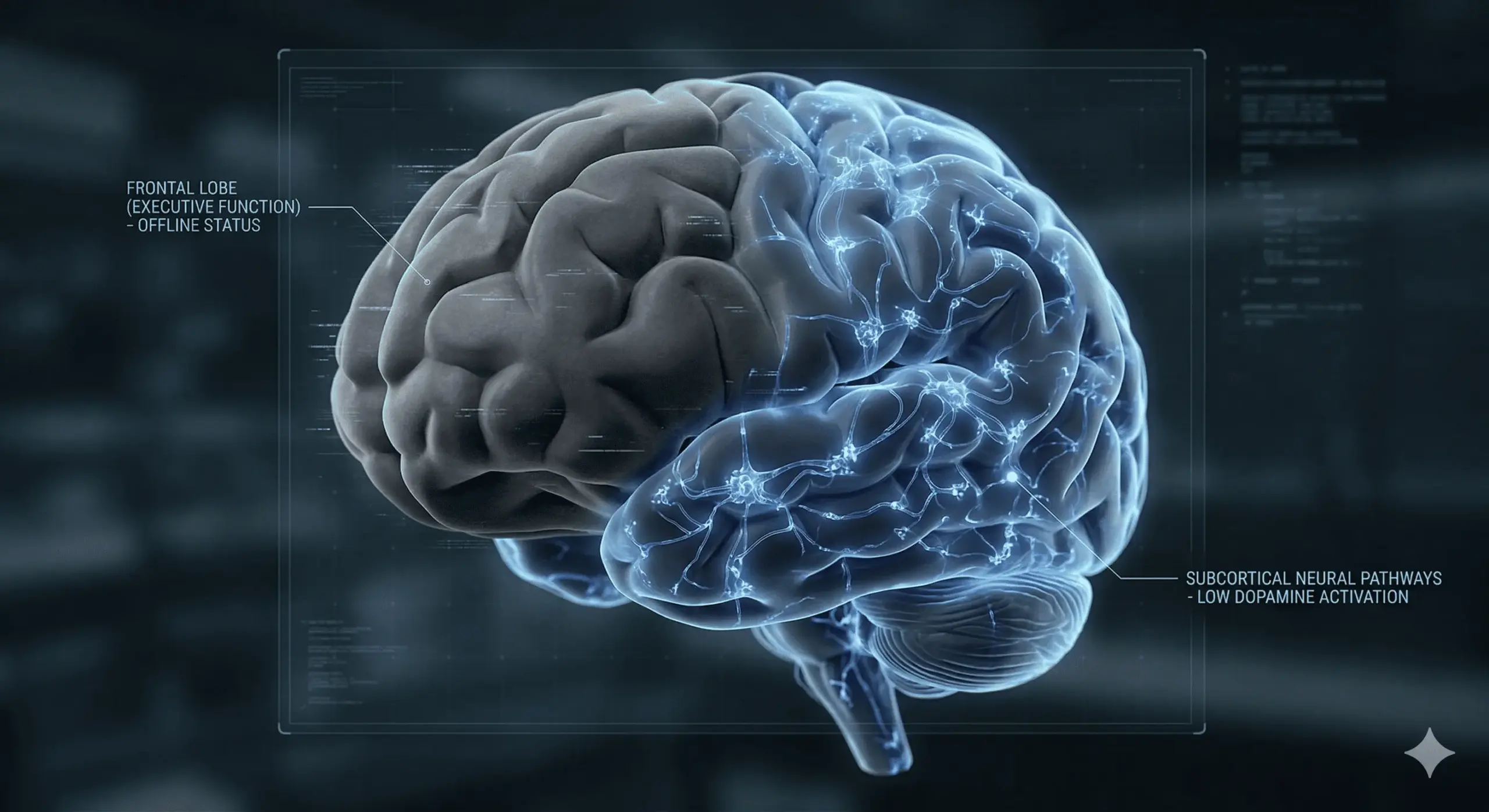
ADHD paralysis occurs when your brain’s executive functioning system—the neural network responsible for planning, organizing, prioritizing, and initiating action—temporarily shuts down under pressure.
In ADHD brains, this system already operates with lower levels of dopamine and norepinephrine—the neurotransmitters that fuel motivation, attention, and task initiation. When stress or overwhelm enters the picture, the whole system can freeze.
Neuroimaging studies reviewed by the National Institutes of Health and published in JAMA confirm that adults with ADHD show measurably lower activation in the prefrontal cortex during tasks requiring focus. Executive dysfunction is not a failure of willpower—it’s a matter of neural efficiency and neurotransmitter availability.
Common ADHD paralysis triggers include:
Decision overload — Too many choices with no clear priority
Perfectionism and fear — High emotional stakes make avoidance feel safer
Understimulation — Low-interest tasks fail to generate enough dopamine to initiate action
Emotional dysregulation — Rejection sensitivity dysphoria (RSD) or anxiety can trigger shutdown
ADHD Paralysis vs. Depression: Critical Distinctions
Here’s where accurate diagnosis becomes crucial. ADHD paralysis and depression can look remarkably similar on the surface, but they have different neurological roots and require different treatment approaches.
Key Differences at a Glance:
ADHD Paralysis | Clinical Depression |
Task-specific or situation-dependent | Pervasive across all life domains |
Can suddenly resolve when task becomes urgent or interesting | Consistently low motivation regardless of circumstances |
Energy fluctuates dramatically (hyperfocus is possible) | Sustained energy depletion |
Strong desire to act but feel blocked | Diminished interest in activities that once brought joy |
Guilt and anxiety about inaction | Emotional numbness, hopelessness, or feelings of worthlessness |
A Real-World Example:
Someone experiencing ADHD paralysis might spend three hours unable to start writing an email, then suddenly hyperfocus for five hours building a complex spreadsheet because it’s novel and engaging.
Someone with major depressive disorder typically experiences consistent anhedonia—the inability to feel pleasure or motivation—even for activities they previously loved. They’re not blocked from starting; they genuinely don’t have the emotional or physical energy to care.
Important note: According to research published in the Journal of Attention Disorders, approximately 50% of adults with ADHD will experience a major depressive episode at some point in their lives. These conditions frequently co-occur, which is why comprehensive psychiatric assessment is essential.
Burnout: The Third Player
Adults with ADHD are especially vulnerable to burnout due to masking—the exhausting process of constantly compensating for executive dysfunction and trying to meet neurotypical expectations without proper accommodations.
Burnout presents as:
- Chronic fatigue that doesn’t improve with rest
- Emotional detachment from work and relationships
- Cognitive fog and memory problems
- Feeling overwhelmed by tasks that used to be manageable
The key distinction: ADHD paralysis is a traffic jam in your brain’s executive function system. Depression is a neurochemical imbalance affecting mood and motivation. Burnout is what happens when you’ve been overcompensating for untreated ADHD for years without support.
Why Accurate Diagnosis Changes Everything
Getting stuck is part of living with ADHD. But why you’re stuck determines how you get unstuck.
Comparison: What Each Condition Responds To
Condition | What You Experience | What Actually Helps |
ADHD Paralysis | Want to act but feel blocked | External structure, body doubling, task breakdown |
Depression | Little interest or motivation across all areas | Therapy, medication, emotional healing |
Burnout | Emotionally and physically depleted | Rest, boundaries, reduced workload, recovery time |
Treating ADHD paralysis with depression interventions alone won’t address the executive dysfunction. Treating burnout without addressing underlying ADHD means you’ll end up depleted again as soon as you return to unsustainable coping mechanisms.
This is why we require comprehensive assessment—not drive-by diagnosis.
At the ADHD Treatment Center of Florida, we use research-grade diagnostic tools and measurement-based care because evidence is king. We’re looking at:
- Executive function testing
- Mood and anxiety screening
- Assessment for co-occurring conditions (over 70% of adults with ADHD have comorbidities)
- Life history and functional impairment evaluation
- Individualized treatment planning
You deserve to know what’s actually happening in your brain—not just get handed a prescription based on a 15-minute questionnaire.
Evidence-Based Strategies to Break Through ADHD Paralysis
These aren’t “just try harder” platitudes. These are ADHD-specific interventions based on how your brain actually functions.

Body Doubling — Work in the presence of another person—virtually or in person. Their presence creates external accountability your brain can’t generate internally. Try Focusmate, Flow Club, or a simple video call with a friend.
Micro-Task Breakdown — Make the first step absurdly small. Not “write the report”—just “open the document.” Task initiation is the hardest part; momentum does the rest.
Time Boxing — Use the Pomodoro Technique (25-minute sprints, 5-minute breaks) to create urgency without overwhelm. A visual timer makes time concrete and manageable.
Externalize Everything — Get tasks out of your head and onto whiteboards, sticky notes, or ADHD-friendly apps like Todoist or Sunsama. Reducing cognitive load makes abstract obligations feel actionable.
Lower the Bar — Done is better than perfect. Give yourself permission to do it badly, halfway, or at the minimum viable level. Perfectionism is often the enemy of action for ADHD brains.
When Self-Help Isn’t Enough: Knowing When to Seek Professional Support
Self-management strategies are valuable—but they’re not always enough. Seek a professional evaluation if you experience persistent low mood lasting more than two weeks, loss of interest in activities you once enjoyed, significant impairment at work or in relationships despite trying multiple strategies, or thoughts of worthlessness, hopelessness, or self-harm.
Start with our free ADHD quiz to better understand your symptoms before your first appointment.
At the ADHD Treatment Center of Florida, we treat the whole person—addressing ADHD and any co-occurring conditions with evidence-based interventions including medication management, therapy, coaching, and wrap-around support. If you’re a Florida resident between 18–59, schedule a comprehensive assessment and get real answers—not a 15-minute drive-by diagnosis.
Frequently Asked Questions
What does ADHD paralysis feel like?
It feels like being mentally frozen despite wanting to act—staring at a task for hours, experiencing intense guilt, and feeling physically restless while mentally immobile. Unlike laziness, you genuinely want to complete the task, but your brain’s executive function system is temporarily offline.
How is ADHD paralysis different from procrastination?
Procrastination is a choice to delay. ADHD paralysis is involuntary—your brain’s executive function shuts down under stress or overwhelm, making task initiation neurologically difficult, not a matter of preference.
Can ADHD paralysis and depression occur together?
Yes. About 50% of adults with ADHD will experience major depression at some point. Because symptoms overlap but treatments differ, comprehensive assessment is essential.
What’s the fastest way to break through ADHD paralysis?
Start with body doubling and a micro-task (e.g., “open the document”). Add a 15–25 minute time box to create urgency. These external structures compensate for what the ADHD brain struggles to generate on its own.
You’re Not Lazy—You’re Human
ADHD paralysis is not a character defect. Depression is not weakness. Burnout is not failure. These are human responses to neurological differences, chemical imbalances, and prolonged stress—and they deserve compassion, not judgment.
Naming what you’re experiencing is powerful. It gives you permission to stop the shame spiral and start implementing solutions that actually match your brain’s needs.
All ADHD lives can be better. But better starts with understanding.
Ready to understand your brain? Take the free ADHD quiz or book your comprehensive assessment at the ADHD Treatment Center of Florida today.

Adult ADHD Symptoms: 10 Signs You’ve.
What Does ADHD Actually Look Like in Adults? Most adults with ADHD aren’t bouncing off walls — they’re the overworked.
Read More